How Carbon Credits Bring Corporate Capital Into Climate Finance
Most of the finance that protects the natural systems on which the climate depends is public, and there is considerably less of it than the task requires. Carbon credits are among the few channels through which private capital reaches that work, and the net-zero standards, compliance schemes and international mechanisms that determine how they are used have moved, within the past year, from proposal to practice.
 For two decades the market for carbon credits ran on the spot trade. A company bought tonnes that had already been verified and issued, retired them and reported the result. Last year the pattern changed. Agreements to buy credits from projects not yet delivering exceeded direct investment in projects for the first time, with commitments over the year amounting to US$22 billion. Corporate buyers supplied US$14.2 billion of it, more than three times the figure for 2024, spread across more than a hundred companies. Buyers who contract years ahead do so because they expect supply to be scarce and want first call on the projects they have chosen. They are also, in effect, the financiers who decide which projects get built.
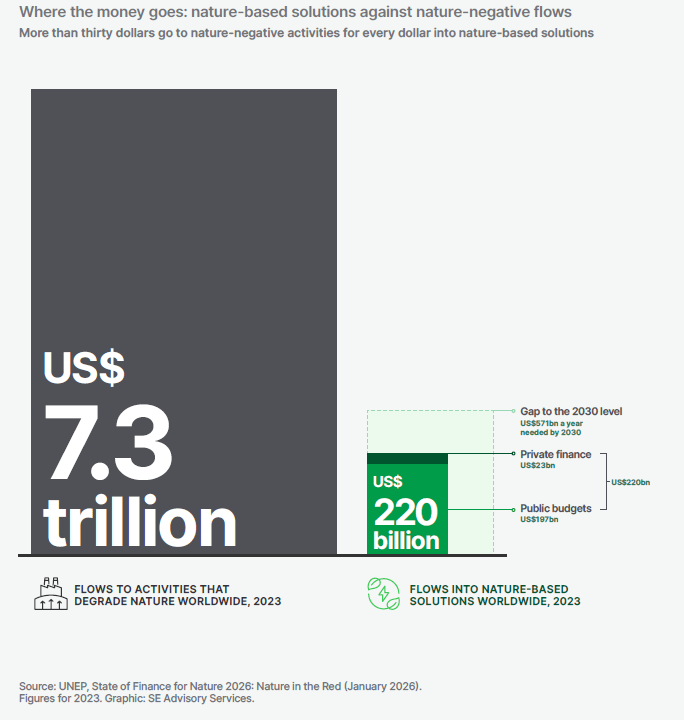
To understand why they are doing it, start with who pays for climate action today. In January, the United Nations Environment Programme worked through the accounts. Of the US$220 billion that went into nature-based solutions in 2023, public budgets provided US$197 billion. The imbalance says more about how the system is built than about who is willing to pay. Governments own the land, sign the treaties and answer for the targets. Private investors, for their part, have had few ways to pay for a verified environmental outcome that an auditor would accept. The result is a system leaning on one source, and a stretched one. The same report found that US$7.3 trillion flowed that year into activities that degrade nature, roughly thirty times what went into restoring it.
.
Governments have said as much themselves. The Independent High-Level Expert Group (IHLEG) on Climate Finance, which advises the UN climate talks, expects about half of the external money developing countries will need by 2035 to come from private investors. Carbon markets are on its short list of ways to move it. A credit pays for a result that has already been verified, it can be traced from the project to the company that retires it, and it leaves the host country no more indebted than before. Few instruments combine all three.
Where Carbon Credits Sit Alongside Deep Emissions Reductions
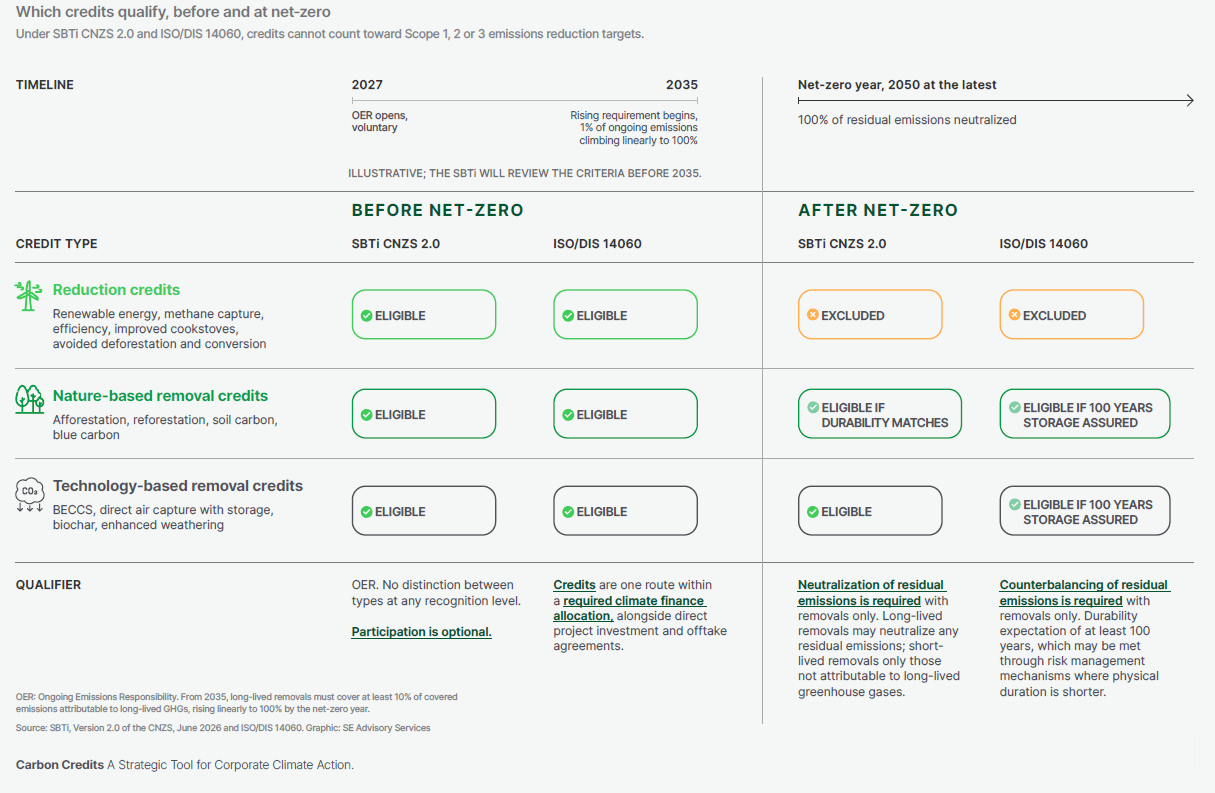
The frameworks that companies report against have caught up with this. In June, the Science Based Targets initiative (SBTi), the body against which most large companies validate their emissions targets, published version 2.0 of its corporate net-zero standard. It kept the rule that credits cannot count toward a company's own reductions. It added, for the first time, formal recognition for companies that finance mitigation beyond their value chain while meeting those reductions, and a benchmark for the contribution of US$20 to US$80 per tonne of the emissions a company continues to produce. Companies must say at validation whether they will take part. Those that decline must explain why in writing. A question that had hung over corporate carbon budgets since the standard first appeared in 2021 now has a defined answer, at least within the SBTi's framework.
.
The International Organization for Standardization (ISO) had been expected to land on a similar design with ISO 14060, which would be the first net-zero standard a company could be audited against. Its draft treats credits much as the SBTi does. They sit outside the reduction pathway, all credit types count toward a contribution to global net zero, and only removals may counterbalance what remains at the net-zero year. It goes further on what a portfolio should contain, asking for nature-based removals alongside technological ones, because reaching net zero will require both. It also ties financed activity to the health of natural sinks: forests, soils and wetlands are to be preserved and restored, deforestation eliminated, and the communities on the land engaged in planning the work. After the consultation closed on September 9, ISO's members asked for the draft to be revised before it advances, and the committee is now working through close to 5,000 comments.
Meanwhile, demand is arriving from the compliance side. Under CORSIA, the aviation offsetting scheme, airlines must by January 31, 2028, cancel credits covering the growth in their international emissions since 2024, a volume the industry's trade body puts at between 146 million and 236 million tonnes. From 2027 the scheme becomes mandatory and Brazil, China, India and Russia, which sat out the voluntary phases, join it.
The European Union, for its part, has agreed that part of its 2040 target may be met with international credits from 2036. Article 6 of the Paris Agreement, the mechanism by which countries trade mitigation between themselves, is running, with the first credits issued this year under its UN-supervised arm. All of these buyers draw on the same projects that supply companies. A project takes years to go from a plan to an issued credit, so the supply that will meet that demand is being paid for now, by the companies in the first paragraph.
Choosing Where the Contribution Goes
What the standards and the schemes leave out is that a carbon credit is a claim on somewhere in particular. Most corporate carbon finance goes to standing forest, watersheds and farmland. A survey of suppliers late last year found forestry and land use dominating buyer inquiries by a wide margin. Those are the landscapes where the funding gap is widest. They are also, often, the ones a company's own supply chain runs through. A firm that pays to keep a watershed working upstream of the farms it buys from is doing something the climate accounts record as mitigation and its own operations experience as continuity. Few other instruments let a company address a global shortfall and a private dependency with the same money.
The frameworks give a company a defensible place to start and a benchmark to size a commitment against. Beyond that, the choices are the company's own, and they are the subject of the 2026 edition of Carbon Credits: A Strategic Tool for Corporate Climate Action, launched at Climate Week NYC in partnership with Arden Climate.
When we published the first edition in 2024, the open question was whether companies should be in this market. Two years on, the SBTi has written contributions into its standard and airlines are buying to cover the first-phase obligations under CORSIA, so that question has largely settled itself. The new edition is about making that contribution count: how much to commit, in what sequence to build a portfolio of reductions and removals, how far ahead to contract, and which landscapes the capital should protect.
For the full analysis, download the 2026 Carbon Credits playbook here.
.
Contributor:
Isabel Fernández de la Fuente, Senior Manager Communications & External Affairs - Energy Management