Why Does So Much of the Financial Value of Sustainability Go Uncaptured?
Conviction is No Longer the Problem
For a decade, sustainability had to argue for its place in corporate strategy, and that argument has largely been won; the harder question now is capture, or why returns that recur reliably across operations, supply chains and the cost of capital still reach the bottom line only in part.
 What separates the firms that capture this value from the rest is rarely ambition, since most already have the targets and the intent, and in many cases the raw data too; what they lack is a way to use it, because that data tends to sit scattered across systems that were never designed to speak to each other, still less to the people allocating capital, and so it seldom becomes a number a CFO can act on. Closing that gap takes two things: the digital capability to turn scattered inputs into decision-grade figures, and the governance to carry them through to a decision.
The Capability That Decides the Outcome
SE Advisory Services’ analysis with IESE Business School’s Institute for Sustainability Leadership describes this as a capability multiplier: the value a company captures is the value at stake times its capability to act on it, and that capability rests on two foundations, governance and digital systems.
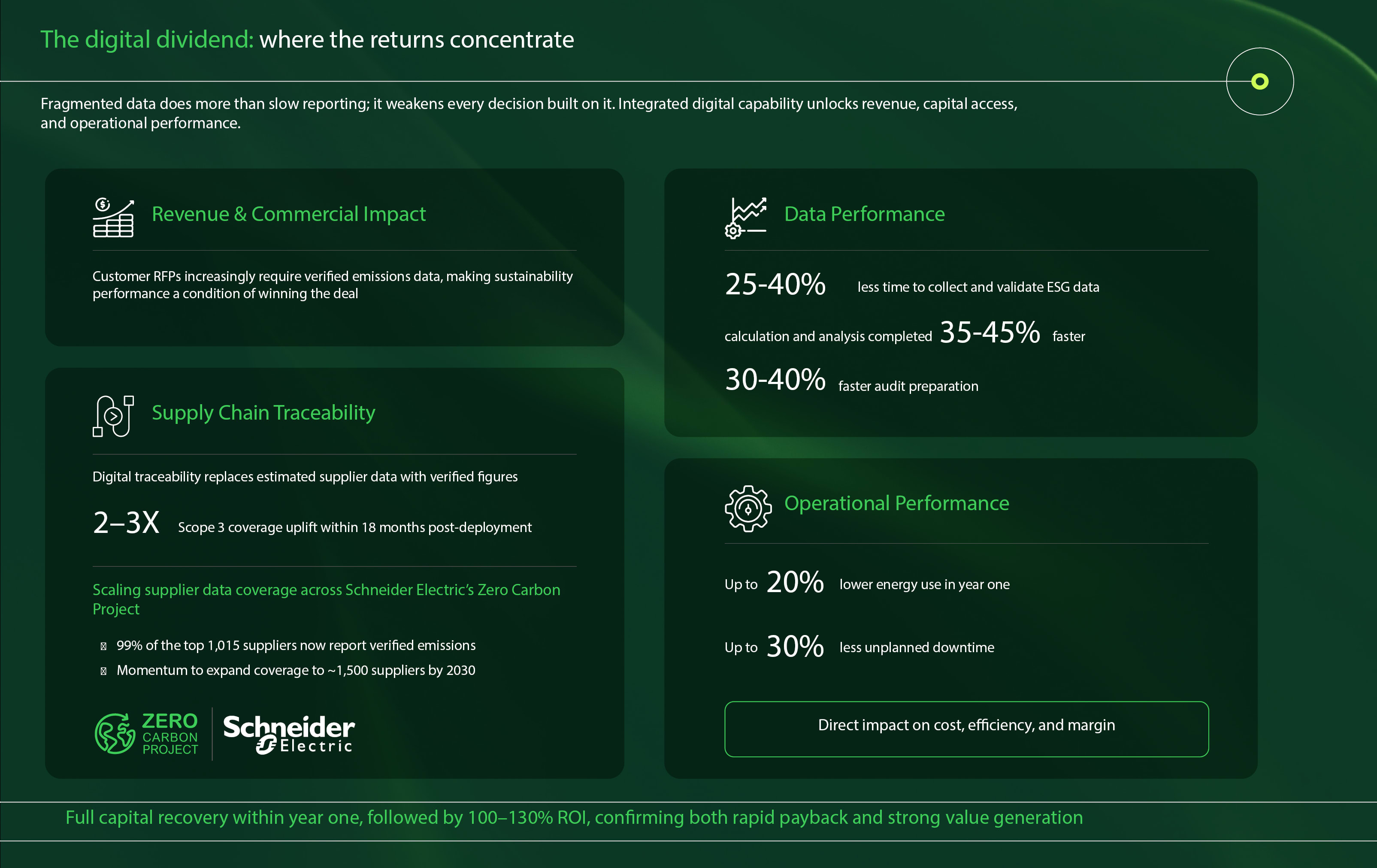
Governance in this sense is the discipline of making sustainability a shared responsibility across functions rather than left to a single team, a point the room returned to repeatedly at the roundtable we convened at The Climate Group's Opportunity Summit during London Climate Action Week in June 2026. And because measuring exposure and acting on it both run on digital infrastructure, digitalization is the lever that decides the result.
.
.
Where the Value Leaks
The leak tends to take the same form wherever it appears, and energy is the most immediate case. Drawing on SE Advisory Services’ work across more than 1,100 industrial energy projects, savings of 15 to 20 percent are typical, yet most companies weigh an efficiency investment on the energy line alone, because that is all their reporting shows them. Put continuous, asset-level monitoring in place and the rest comes into view, from lower maintenance bills and less downtime to steadier output, so that the same project, measured in full, is worth far more than the meter suggests.
The executives around the table at the Opportunity Summit made the same point from their own experience: once efficiency gains, reduced downtime and the cost of inaction are quantified and communicated internally, sustainability can be argued for on the same terms as any other investment. The same blindness that undercounts the upside lets unpriced risk compound until it reaches the balance sheet, by which point the options are fewer and costlier.
The Same Story Across the Business
The pattern repeats wherever sustainability touches the P&L. In the value chain, firms that can finally see their Scope 3 emissions turn that visibility into resilience and better terms. In one scenario analysis SE Advisory Services ran with a global retailer, a four-year shift to circular business models, repair, rental and second-life offerings among them, was modeled to add up to €1 billion in incremental revenue. Much of that value, though, depends on the smaller suppliers up and down the chain, and here the Summit surfaced a gap of a different kind: these firms can move quickly, yet many are holding back until their larger customers explain the strategy and the part they are expected to play in it, which makes engaging them a condition of delivery rather than an afterthought. In access to capital, lenders increasingly price verified performance into the cost of borrowing; in one SE Advisory Services engagement, a global manufacturer built its decarbonization roadmap to the criteria its investors and lenders required, and meeting them unlocked roughly €100 million in sustainability-linked financing on more favorable terms.
Reporting is Not the Destination
Most companies stall at this point, reporting, often well, and mistaking the report for the result, when the money is made one step further on, where the same data shapes capital allocation and how operations are run. The updated Science Based Targets initiative (SBTi)’s Corporate Net-Zero Standard Version 2.0 reflects that shift from ambition to implementation, and it echoes something the room at the Summit was clear about: that treating sustainability as a compliance exercise is precisely what keeps it from reaching the decisions that matter. The progression is orderly, from reporting to measuring to managing to capitalizing.
The Question for the Board
Stripped down, the question facing directors is a narrow one: whether sustainability is worth the investment has largely been settled, and what remains is whether the company is built to act on what it already knows. The firms pulling ahead are seldom the most ambitious or the best at disclosure; they are the ones that have connected sustainability to capital allocation, tied incentives to delivery, and learned to state performance in the language of finance, a point made more plainly still at the Summit: that the case travels furthest when it is made in the terms a board already uses with its shareholders, energy security and risk among them, rather than in sustainability's own vocabulary. The rest are leaving money on the table, quietly, year after year.
Closing that gap is the work we do at SE Advisory Services. At its core is Resource Advisor+, our AI-native platform that draws carbon, energy, supply-chain and climate-risk data into a single view — recognized among the leaders in carbon management software by both Verdantix and IDC. Around it we bring the advisory, engineering and delivery to act on what that view reveals: strategy and execution under one roof.
The Summit offered a concrete illustration. One company described winning board backing to extend the payback it would accept on sustainability investment from the usual two or three years to eight or nine, and although the projects themselves were unchanged, the governance around the decision was enough to make the investment straightforward to defend.
Markets rarely move one company at a time; they move when enough boards act together, which is why the conversation at the Summit turned to sector coalitions, shared benchmarks and a readiness to revisit targets that no longer fit. All of which leads back to where the report began: the value is there, and it goes, for the most part, to the companies that build the capability to act on it.
Read the full report, The Financial Case for Sustainability: How Much Value are Companies Leaving on the Table?
.
Contributor:
Isabel Fernández de la Fuente, SE Advisory Services