The Electrification Staircase: A Strategic Roadmap for Europe’s Transition to Electrification
The Age of Electricity
 Since the industrial revolution, European economies have relied on abundant and available on-demand fossil fuels. That model is now proving unsustainable and obsolete in the face of the climate crisis and the rapid expansion of renewables. In 2025, wind and solar surpassed fossil fuels for the first time as the main source of electricity in the EU, generating together 30% of EU electricity [1]. At the same time, renewable technologies are now cost-competitive with conventional power plants and the majority of newly installed renewable capacity is cheaper than fossil-based alternatives [2]. As the International Energy Agency describes it, we are entering the Age of Electricity, a new era in which electricity becomes the dominant energy carrier and electrification is the critical enabler of the energy transition [3].
The Power of Electrification
The war in Ukraine exposed just how vulnerable Europe’s fossil-fuel supply chains are, plunging the continent into a severe energy crisis. Energy security and autonomy have become central to maintain European competitiveness in the globalised economy. Electrification can play a decisive role in this by reducing dependence on volatile oil and gas markets and limiting risks of supply chains disruptions caused by geopolitical shocks. The EU imports most of its fossil fuels, whereas electricity is predominantly generated from domestic sources [4]. Therefore, electrification is a strategic pathway for strengthening Europe’s energy resilience.
Energy economics reveal another structural vulnerability in Europe’s energy system. Electricity bills in Europe carry higher taxes, levies and network charges per unit of energy compared with gas [5]. Such discrepancy is even more striking when considering that electricity taxes include surcharges that were introduced to finance the transition to renewable energy [5]. Even so, the average electricity-to-gas price ratio in Europe has halved from around 4 in 2017 to about 2 in 2024 [5], showing how electricity is increasingly becoming cost-competitive with gas and improving the economics for electrification. Addressing this energy-pricing imbalance through targeted policy will be essential to accelerate electrification.
If reducing operational costs is essential, electrification brings an additional benefit: efficiency. Electric technologies generally outperform combustion-based systems in energy conversion, reducing energy waste and amplifying the economic gains from electrification. But electrification goes far beyond improving conversion efficiency, it enables re-thinking how processes are designed. Let’s look at industry as an example. Many industrial facilities rely on a centralised steam system that delivers the same high temperature to multiple processes. This one-size-fits-all approach often leads to substantial energy losses, particularly for operations that could be run at lower temperatures or with hot water. On the other side, technologies like heat pumps upgrade low-temperature heat from air, water, or waste-heat streams. This enables a more precise matching of heat supply to process needs with reduction of energy losses. It also facilitates the integration of waste-heat recovery, unlocking energy-optimisation opportunities greater than through improvements of conversion-efficiency alone. In essence, electrification could transform how thermal processes are designed, from an inefficient heat-downgrading approach, to one where heat is reused, upgraded and optimized to match exact thermal needs.
The switch from fossil fuels to renewables, marks a profound shift from consumption patterns built on continuous, on-demand fossil energy availability, toward one shaped by the variability and time-dependency of wind and solar. As a result, electrification and flexibility are intrinsically linked. When hybrid fossil-electric systems are in place, users can modulate their electricity consumption to take advantage of periods when low-cost electricity is abundant via load-shifting. Likewise, electric-based technologies can provide dispatchable loads depending on their configuration. For instance, electric heaters coupled with thermal storage can shift consumption by storing heat during periods of low-priced electricity periods, releasing it when prices are higher. In addition, many electrically powered batch processes, such as materials grinding in electric mills, offer operational flexibility as their production cycles can be rescheduled to align with favourable price signals, grid conditions, or periods of high renewables availability. Beyond costs savings, electrification can also improve grid stability by enabling end-users to participate in day-ahead or intraday markets, ancillary services markets, and other forms of explicit flexibility. In doing so, it enhances overall system reliability while unlocking new revenue streams and monetization opportunities for the end-users.
When powered by 100% renewable electricity, electrification can eliminate both Scope 1 and Scope 2 emissions. Unlike fossil fuel-based systems, electrified processes do not generate on-site emissions, helping improve local air quality. Concerns about higher emissions from electrification typically stem from the carbon intensity of electricity grids, which can vary significantly across regions. Yet, in Europe the power sector is decarbonising faster than any other, with the carbon intensity of electricity generation falling by 40% over the past 10 years [6]. The carbon reduction potential of electric-powered solutions will only improve as grids decarbonise, thus investing in electrification today avoids the possibility of future carbon lock-ins.
The Electrification Staircase
The Electrification Staircase developed by the Electrification Alliance in collaboration with SE Advisory Services, Schneider Electric’s global consulting practice, Liebreich Associates, and Regulatory Assistance Project (RAP), provides a roadmap of how electrification can advance across industry, residential and transport sectors over time.
It is intended as a practical guide for policymakers, investors, and businesses, enabling the identification of electrification options that are commercially mature (e.g. residential heating and passenger cars), those that are commercial yet have significant potential to deepen adoption (e.g. low-temperature heat in light industries), and those whose viability is more challenging and uncertain, such as shipping and aviation.
While inspired by the Hydrogen Ladder [7], the Electrification Staircase is different in scope. It presents a broad spectrum of applications with electrification potential, illustrating how electric technologies can progressively penetrate across major end-use sectors. In synthesis, the staircase shows that electrification is not only preferable for many applications, but also a clear and unavoidable direction in the energy transition.
As the European Commission prepares to launch the Electrification Action Plan, the Electrification Staircase offers a timely and practical framework to inform strategic choices. It serves as a prioritization tool by providing a step-by-step roadmap that progresses from already commercial, scalable and technically mature solutions (A), to those that are technically feasible but still limited in market uptake (B-C). It then extends to applications facing early-stage technological development, raw materials dependencies, and economic or technical barriers that affect scalability through the 2030s and 2040s (D–E). Finally, it includes the most speculative electrification options beyond 2040, whose viability is characterized by higher uncertainty (F). By mapping electrification options across these six steps, the Electrification Staircase aims to support stakeholders in identifying where to focus interventions, investments and remove barriers to accelerate electrification.
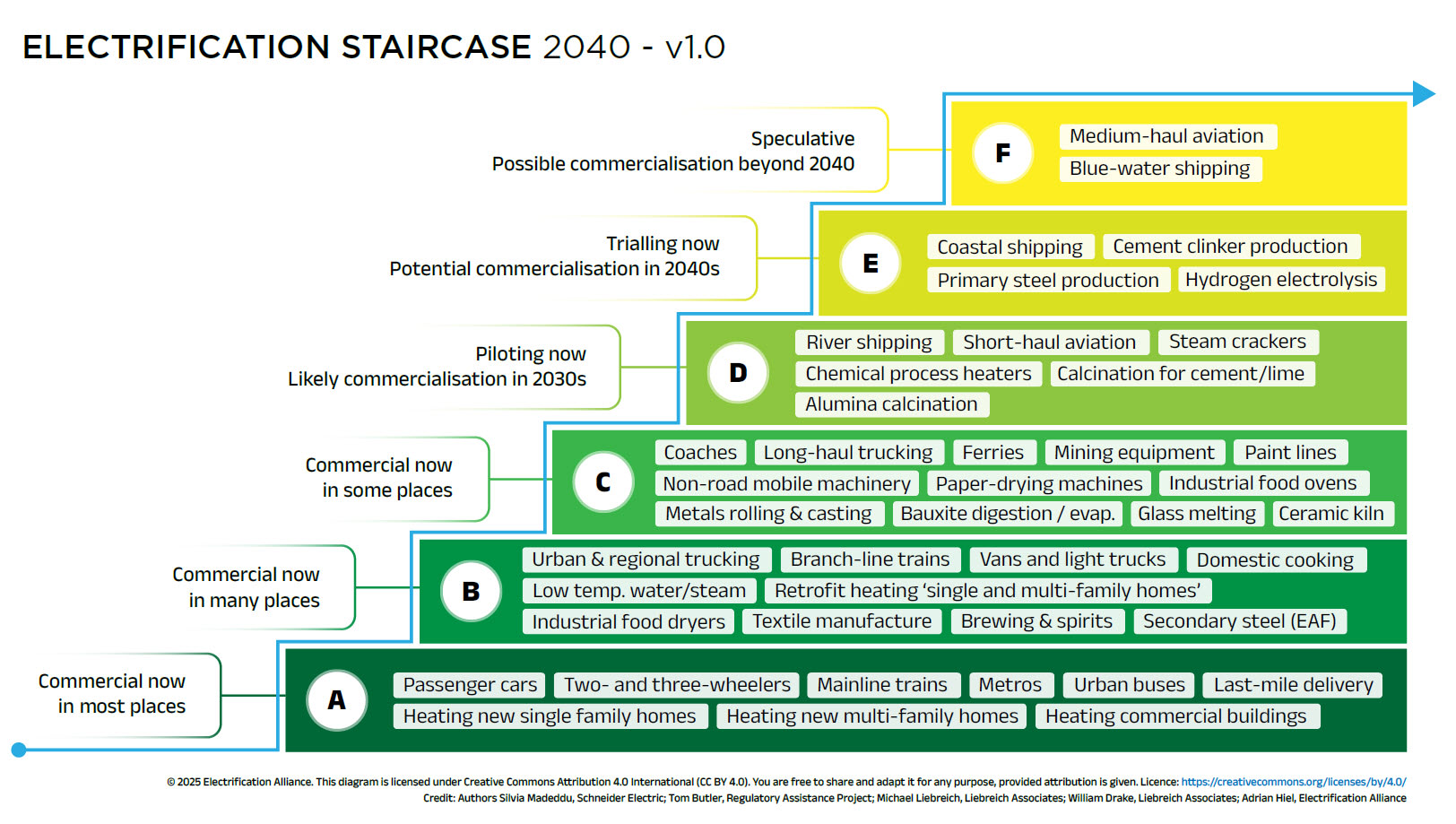
The EU Electrification Action Plan can accelerate the climb up the Electrification Staircase
Accelerating electrification requires a policy and regulatory landscape that creates the right enabling conditions. The upcoming EU Electrification Action Plan will be pivotal in unlocking the opportunities needed for electrification to advance across industry, transport, and residential sectors. Below are the three key action items that should be prioritised in the Action Plan:
- Upgrade and modernise Europe’s electricity grid so it can accommodate more renewable power and meet the increasing electricity demand. Invest in smart grids and digital networks to unlock flexibility in end-use sectors and speed up grid connections for projects that are ready to go.
- Make clean electricity more affordable by reforming taxation to create a level playing field with fossil fuels and by facilitating the access to stable, long-term power price contracts. Provide strong financing tools, such as guarantees, tax incentives, and funding, to help businesses and industries invest confidently in electrification.
- Focus on the most mature electrification opportunities and establish a clear agenda by setting targets and prioritising applications across industry, residential and transport, where switching to electricity can lower operational costs and ensure fast emissions reduction.
Electrification offers a clear direction for Europe’s pathway toward a resilient, competitive, and climate-neutral economy. By modernising grid infrastructure, improving the affordability of electricity, and accelerating the deployment of electric technologies, Europe can unlock the full value of electrification and position itself as a global leader in the energy transition.
To find out more about how SE Advisory Service can support your business get in touch today.
Contributor:
Silvia Madeddu, Solution Architect Team Leader