The Missing Middle in the AI Energy Debate
 Recent conversations about the environmental impact of advanced computing have surfaced some important questions about transparency, energy use, and the temptation to flatten complex issues into overly simple storylines. These conversations have prompted this multi-part series exploring how AI can accelerate, not obstruct, industrial decarbonization.
Much of the public debate swings between two poles: the efficiency of traditional machine-learning systems on one side, and the heavy power demands of large generative models on the other. It’s an understandable comparison. And critics are right to call out the lack of transparency from big tech, a gap that creates an environment ripe for greenwashing, where small climate gains are highlighted while the much larger energy demands of generative AI remain out of view. Sustainability teams have seen this pattern before, and the concern is valid.
But framing the conversation as a tug-of-war between “predictive models” and “energy-hungry chatbots” misses the bigger picture. Those of us building enterprise sustainability solutions know there’s a massive “missing middle” between those extremes. It’s a space where purpose-built, agentic systems operate; tools designed for specific decisions, workflows, and operational outcomes. Their energy profiles and their potential climate benefits look very different from what dominates the headlines.
If organizations hope to stay on track for 2030 decarbonization targets, they cannot afford to reduce the conversation to a false binary. Understanding this middle layer is essential, and it changes how we think about both AI efficiency and climate impact. Here’s why that distinction matters.
The Frontier Model Trade-Off
Frontier models are the heaviest machinery in AI. They're built by a handful of major tech companies you probably know by name, trained on enormous datasets, and require much more computing power — and therefore more energy — every time they run. They're also proprietary, which means we can't see exactly how they work, where they're hosted, or how much energy a single query actually consumes. Open-source models, on the other hand, are transparent and publicly available. We can run them on our own infrastructure, right-size them for a specific task, and make deliberate choices about the energy behind every calculation.
To be clear: at Schneider Electric, we’re not purists. We do use frontier-scale models like Anthropic’s Fable or Opus 5 or OpenAI’s GPT-5.6 Sol, when a problem genuinely requires that level of intelligence. These models can perform complex tasks, typically associated with reasoning, tool-use, and code generation, much better than their smaller predecessors.
But these choices are never automatic. They’re calculated trade-offs. And because major AI providers still keep the actual carbon footprint and energy usage of these models largely opaque, we evaluate each use case with rigor, regardless of footprint or model. This encourages us to carefully weigh the potential physical climate benefits of an agent's task against the estimated environmental cost of the API calls. It is a strict balancing act of ROI: does the climate and business outcome justify the compute?
The Open-Source Frugal Revolution
The good news is that we rely on those massive frontier–scale models less and less. The open-source community is moving at an incredible pace, catching up to and often surpassing proprietary giants. These models are far easier to deploy inside energy-aware architectures. This shift isn’t just promising; it’s reshaping what responsible AI can look like.
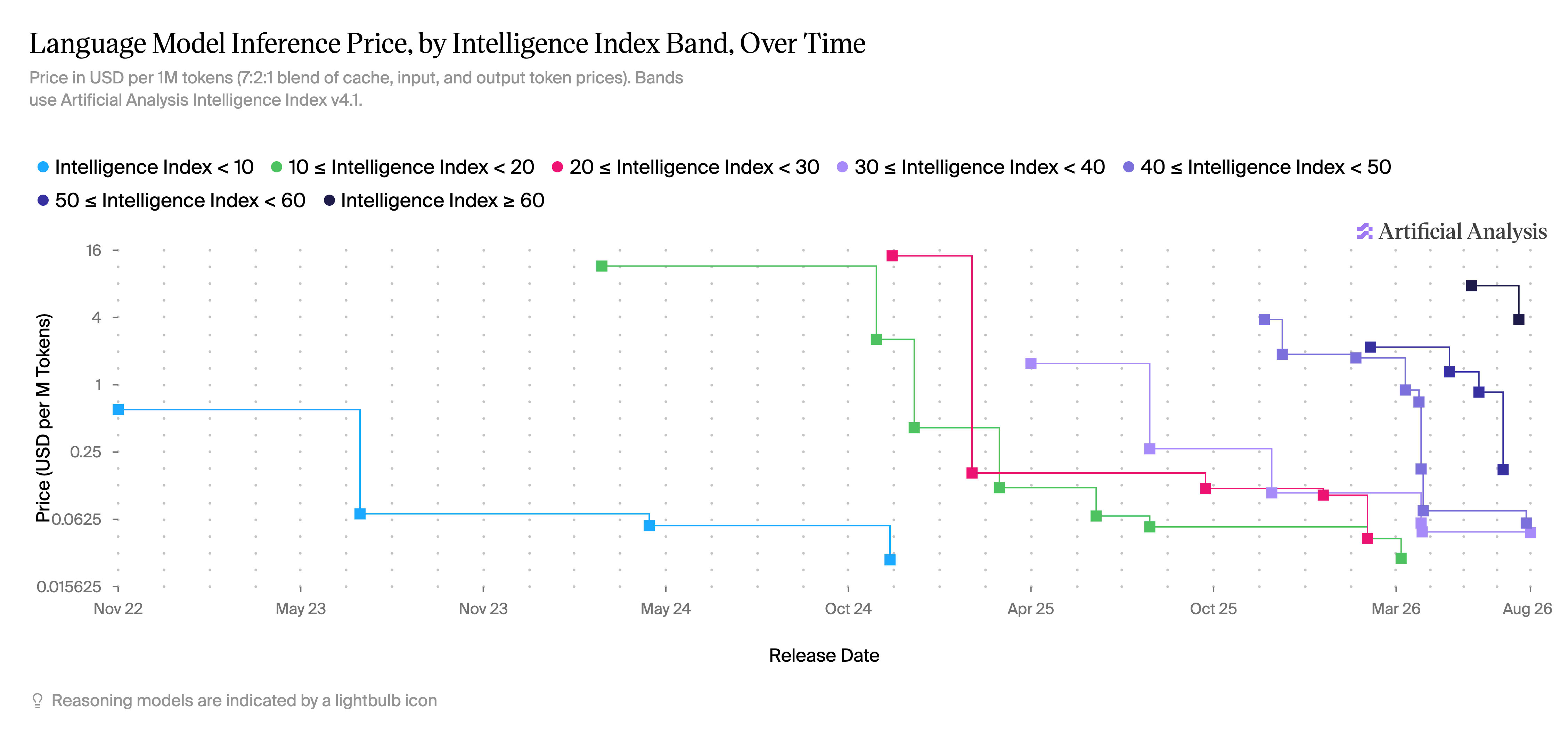
We are now seeing highly efficient, smaller models that can exceed the performance of models like GPT-4o or GPT-4.1 from just a year or two ago. This allows us to more fully embrace Frugal AI. We often don't need a massive, generalized model to detect a structural anomaly in a utility bill or categorize emission activities. By delegating these tasks to smaller, purpose-built models or agents, the energy footprint drops dramatically.
.

Remember the original ChatGPT? On this Artificial Analysis Intelligence Index, it falls below each of the highlighted open-source models, with an intelligence score of 9 and supported by roughly 175 billion parameters (175B). When GPT–4 arrived, its leap in capability felt transformational, powered by an estimated 1.7 trillion (1.7T) and scoring around 13. Today, we have a 2B parameter model from Qwen (Qwen3.5 2B) with an Intelligence Score of 16 and a 0.8B parameter model (Qwen3.5 0.8B) with a score of 11. Whether these models are truly comparable across all dimensions is worth a technical discussion, but nonetheless, it demonstrates this 200-800x increase in intelligence per parameter.
The pattern is unmistakable: the frontier continues to expand, and the capabilities of previous model generations are becoming more accessible through greater openness and smaller model sizes. As a result, organizations can deploy powerful climate-focused AI solutions without relying on oversized, compute-intensive models.
Solving the Scope 3 Data Bottleneck
In the enterprise sustainability world, we aren’t using AI to generate creative writing. We use large language models as reasoning engines inside "Plan-then-Act" architectures, tools built to make decisions, trigger workflows, and accelerate operational impact.
Platforms like the Resource Advisor+ ecosystem use intelligent agents (such as Sera) to automate the ingestion and auditing of millions of data points across global supply chains. This addresses the single greatest barrier to corporate climate action: the data bottleneck.
Mapping Scope 3 emissions is a complex labyrinth that previously consumed thousands of human hours. When a lean agent identifies a 5% efficiency gain across a global manufacturing fleet, the avoided physical emissions vastly outweigh the joules used by the agent to find it.
In other words: impact-per-watt matters far more than compute-per-token.
The Geography of Compute Matters
Treating all AI compute as a monolithic "energy sink" oversimplifies the reality. The carbon footprint of an AI workflow can vary by an order of magnitude depending on where the workload runs. Running smaller models can ease this even further, allowing more ownership of the inference process, including leveraging renewables under the operators’ control.
Many analyses assume worst-case conditions; data centers connected to fossil-heavy grids. But when workloads are anchored in low-carbon regions like Sweden (wind/hydro) or France (nuclear), the carbon footprint changes dramatically. The goal shouldn't be to avoid LLMs; it should be to find ways to use them for the right use cases that produce real value while simultaneously making sure our use is as efficient as possible. This is operational strategy. And it’s a strategy that Schneider Electric has been advocating for decades: energy efficiency depends as much on location and infrastructure as on technology itself.
The Bottom Line
The unchecked, generalized growth of consumer AI is a valid climate concern. But for industrial decarbonization, the transition from "managed spreadsheets" to "automated impact" requires intelligent agents capable of navigating complex, messy, real–world data.
The path forward is clear:
- Lean, open-source models first, delivering high intelligence at dramatically lower energy cost.
- Frontier models as a calculated trade-off, not a reflexive default.
- Strategic grid geography to ensure compute runs on the cleanest electrons available.
- Agentic systems over generic chatbots, focused on measurable outcomes, not novelty.
When we make these design choices deliberately, AI becomes exactly what it must be in the climate transition: a force multiplier for resilience, not a driver of emissions.
Our position is simple and unwavering; we do not fear AI’s energy demands; we consciously recognize them and build our tools to limit our impact. And in doing so, we unlock the intelligence needed to accelerate decarbonization at scale.
To learn more about our team’s evolution with agentic AI and continue the conversation, visit Resource Advisor+.
.
Contributor:
Jeff Willert, Director of Data Science, SE Advisory Services
.
Reference: