Your Next Capital Budget Starts with Today’s Facility Data
How public leaders can turn facility condition data into more competitive capital project requests
Every budget season, worthwhile capital improvement requests lose to better-documented ones. A roof at the end of its life or a chiller operating past its rated service life can both be deferred when the request behind them amounts to a repair history and a rough replacement cost. Over the last 30 years of work with the public sector, we've seen that the projects that 'win' budget season include a defined scope, a credible cost range, and the documented consequences of waiting.
By the time budget season arrives, it may already be too late to build a strong case for a facility project. That evidence takes time to assemble, so requests are often built from memory and open work orders instead of verified portfolio data.
The fix is a matter of timing as much as data. Leaders that start a Facility Condition Assessment (FCA) timed 9 to 12 months before your organization's capital requests are ranked arrive at budget season with a strong case in-hand.
Building the case for capital investment
A strong capital request to a finance director, board, or council needs to answer four questions:
-
- What problem does this project solve?
- What happens if the work is deferred for a year or two?
- What does the work include, and which assets are involved?
- What will it cost at a planning level and how will it be funded?
A typical FCA supplies the evidence behind the first three. It documents what the organization owns, the condition and remaining life of each asset at a portfolio level.
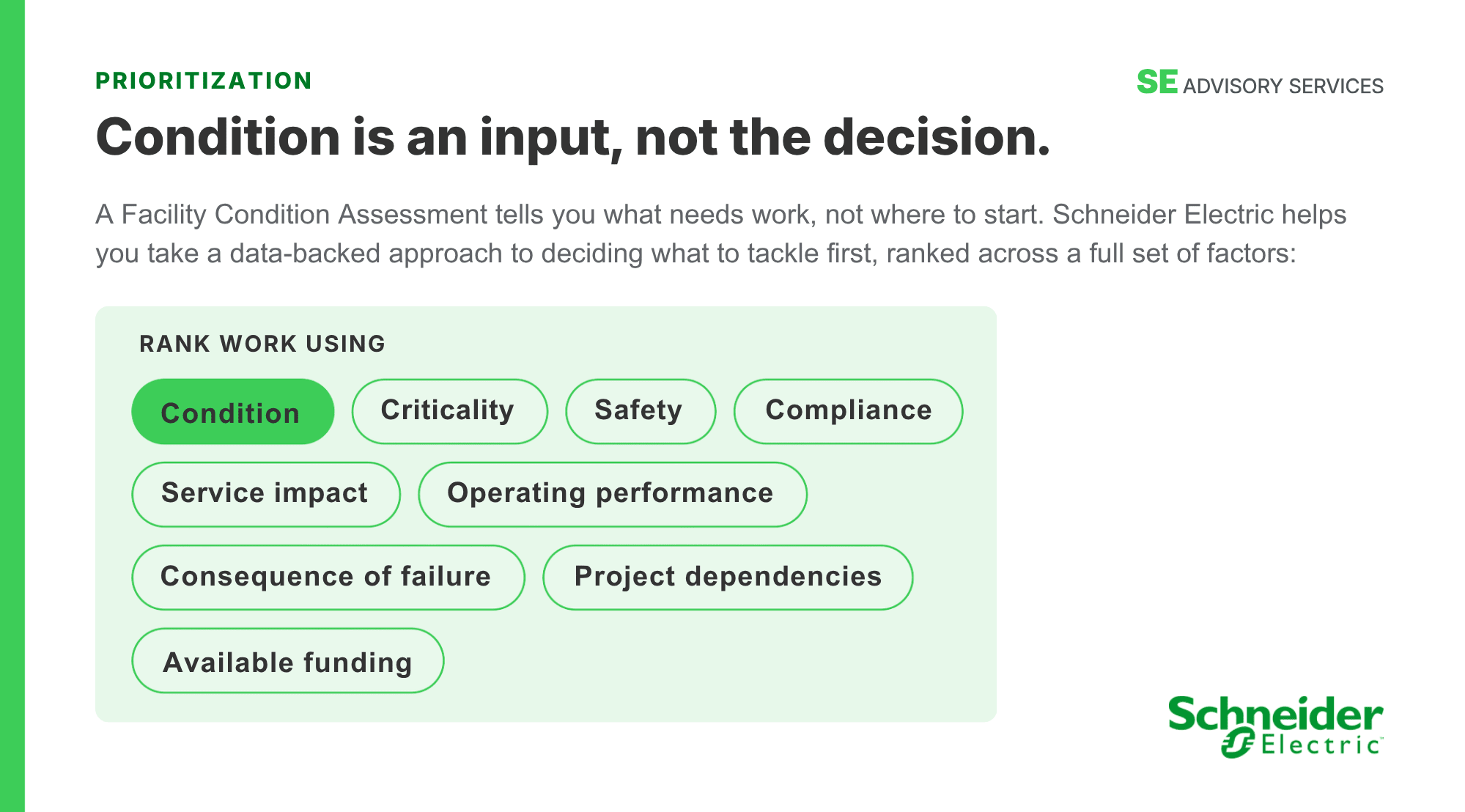
Schneider Electric’s FCA approach answers all four by pairing this onsite assessment with lifecycle cost analysis and risk-informed prioritization. That gives facilities staff a workable delivery plan and a plain reason one project should rank ahead of another.
When to start building your capital request
Our experienced advisors recommend that an FCA intended to support a substantial modernization initiative needs a 9–12-month runway before capital requests are ranked, depending on the organization type.
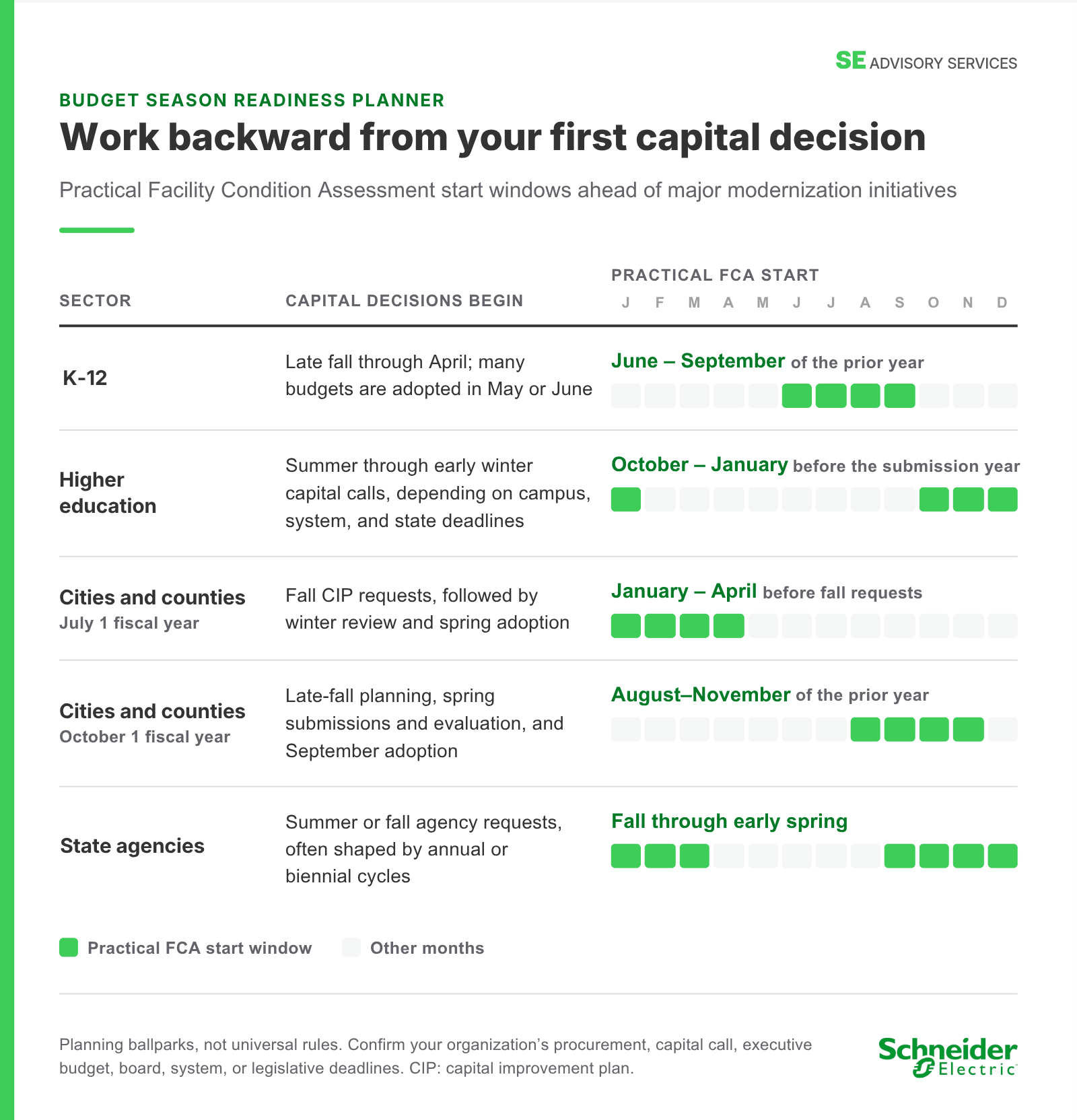
Here is what should be finished, and decided, at each stage of the runway before the next one begins.
-
- 9–12 months out - Decide what the assessment needs to prove, then scope it to match. A district weighing a bond program needs condition data on every building. A college trying to get one central plant replacement approved needs a closer look at that plant and the systems tied to it. Scope drives the cost, schedule, and procurement route, so settle it before fieldwork starts.
- 6–9 months out - Complete fieldwork and have facilities staff check the results before anyone else sees them. The people who maintain your buildings will catch the boiler that was replaced last summer or the roof leak that is already on a work order. One visible error in front of finance weakens every other number in the request.
- 3–6 months out - Group identified needs into projects with cost ranges and sequence by priority. Related work belongs together, so an end-of-life air handler, its controls, and the electrical upgrade behind it are one project, not three requests.
- 0–3 months out - Choose the funding path and write the request. Check the cost estimate against reserves, bond capacity, grants, or financing, and confirm if the operating budget can absorb new ongoing costs once the project is built.
Keep the case current
A conventional FCA is a snapshot. A year after it is created, completed projects will still appear as if they’re in the backlog, projects costs reflect the year they were estimated, and high-risk assets will have continued to age unchecked. If your organization already has an FCA, re-check it for accuracy before relying on it next budget season. The Government Finance Officers Association (GFOA) advises keeping asset inventories current and updating facility condition ratings every one to three years, more often for high-risk assets.
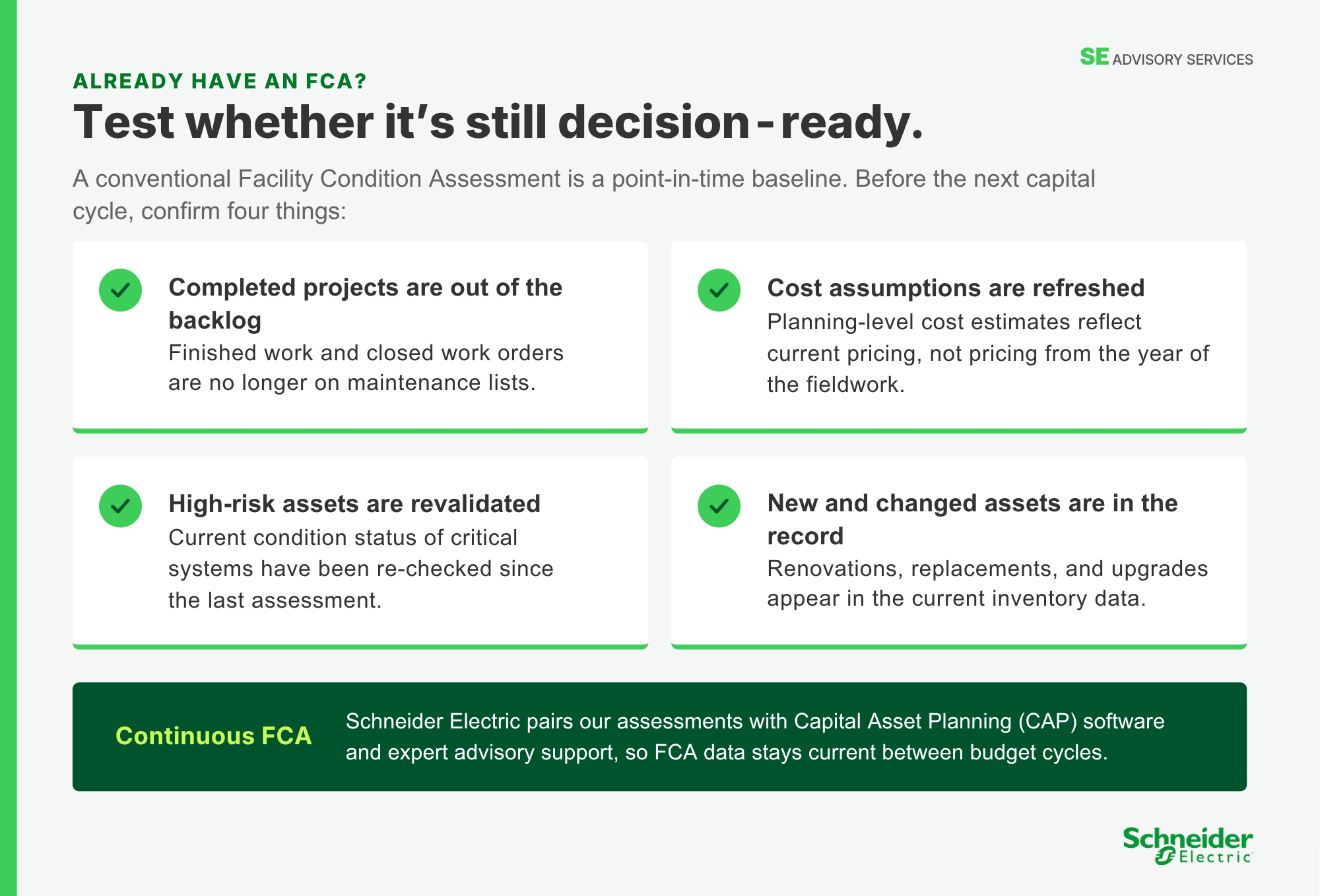
Schneider Electric's Continuous Facility Condition Assessment keeps your data decision-ready between budget cycles. We pair it with Capital Asset Planning (CAP) software and a dedicated advisor. CAP maintains the inventory, lifecycle forecasts, project assumptions, and funding scenarios. The advisor helps turn ranked priorities into scoped, sequenced projects that fit available capital and work around academic calendars and seasonal demand.
That allows your organization to enter each budget season with a capital roadmap it can defend, instead of a list of needs it has to rebuild every year. Learn more about Schneider Electric’s Capital Asset Planning approach.
Turning facility needs into fundable projects
A Facility Condition Assessment creates value when it turns facility needs into a defensible capital plan. An FCA lets every funding request trace back to an observed condition, a documented risk, and a defined project scope. That trace is what backs you up when a board member asks, "why this project, and why now?"
Is your facility data ready for the next capital planning cycle? Schneider Electric can help your organization build an FCA, keep asset data current, and develop a modernization roadmap around your approval calendar. Connect with a local expert today to get started.