Municipal Facility Planning During Financial Upheaval

How Citrus County, FL funded facility needs without losing sight of community priorities
 In the years following the 2008 recession, Citrus County, Florida faced a challenge familiar to many public agencies today: facility needs were not going away, but available capital was severely limited. County buildings still had to serve residents. Staff still needed safe, comfortable places to work. Libraries, government offices, and emergency services still had to perform reliably. At the same time, public dollars were under pressure, so the County’s leaders had to make careful decisions that could stand up to public scrutiny.
Citrus County’s response offers a practical lesson for other public sector organizations navigating financial uncertainty: use existing operating expenses more strategically.
The Challenge: Improving Facilities Without Adding Pressure to the General Fund
After the economic slowdown of 2008, Citrus County was working within the same constraints affecting many local governments across the country. Essential services had to continue, but discretionary funding was harder to come by.
In particular, the County had a growing list of facility needs. Projects on the capital improvement plan had been pushed out, but delaying maintenance indefinitely carried its own risks: higher long-term maintenance costs, energy in-efficient buildings, and increased strain on staff and operations.
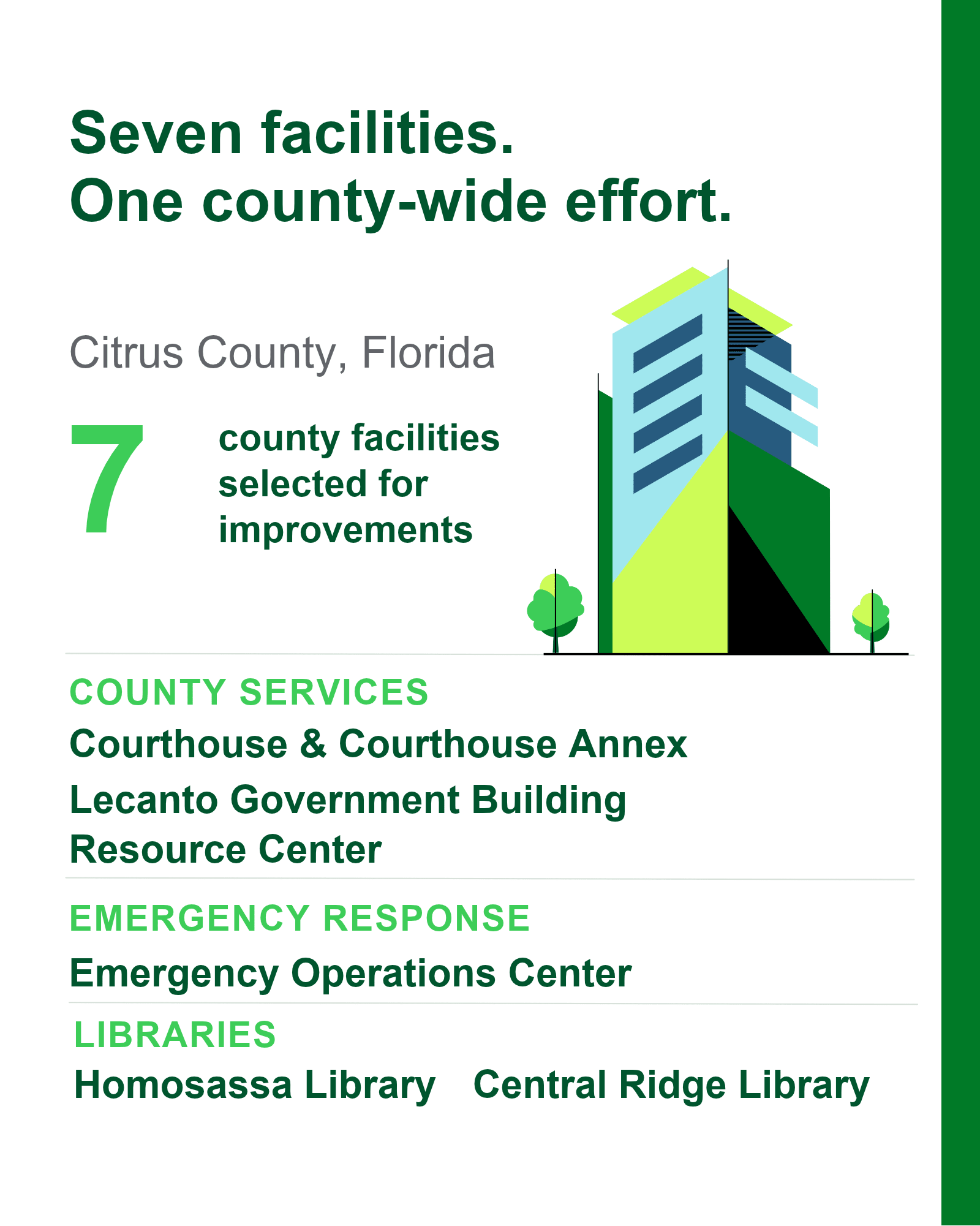
Citrus County identified seven facilities where facility improvements would lower operating costs, support essential county functions, and make better use of tax dollars being spent on utilities. These buildings also support essential county functions and public access. But addressing their needs required upfront capital investment.
For public agencies, the success of a project depends not only on technical performance, but also on trust, documentation, and the ability to explain the decision clearly to residents, boards, and stakeholders. At the time, County leaders had to weigh several important questions:
-
- Could these facility improvements be funded without depleting scarce capital reserves?
- Would the savings created by these upgrades be real, measurable, and defensible to the public?
- Could the County avoid creating additional financial risk?
- Could improvements be made without disrupting resident services or adding additional administrative burden to county staff?
The Solution: Turning Utility Savings into Facility Investment
In 2012, Citrus County selected Schneider Electric from a field of ten energy services companies to develop and implement efficiency improvements across the seven selected facilities.
The approach was built around a guaranteed energy savings performance contract (GESPC).
Instead of relying solely on new capital funding, the GESPC allowed the county to use savings in utility and operational costs to help pay for needed infrastructure improvements.
In plain terms, Citrus County was able to recapture money it was already spending on energy and redirect a portion of those savings toward facility upgrades.
The project included approximately $2.9 million in infrastructure improvements designed to reduce utility costs by more than 28%, equating to savings of more than $4 million over the 15-year contract term. And those savings were guaranteed. In other words, if verified savings fell short, Schneider Electric would cover the difference. This structure gave County leaders a clear path to lower risk and assure both accountability and long-term value.
Implementation: Practical Upgrades Across County Facilities
Citrus County’s project focused on improvements that would reduce operating costs while enhancing building performance and overall fiscal responsibility. Key measures included:
-
- County-wide lighting retrofits to brighten the working environment for staff
- Replacement of chillers to improve efficiency and reliability
- Expansion and recommissioning of the building automation system
- Improvements to comfort, controls, and energy management
- Upgrades designed to support long-term facility performance
Schneider Electric served as the County’s partner for audit, design, implementation, funding support, and performance accountability. The project also allowed for the use of local subcontractors where possible, keeping the project grounded in the community while benefiting from Schneider Electric’s global expertise.
The Impact: Lower Costs, Better Facilities, More Budget Certainty
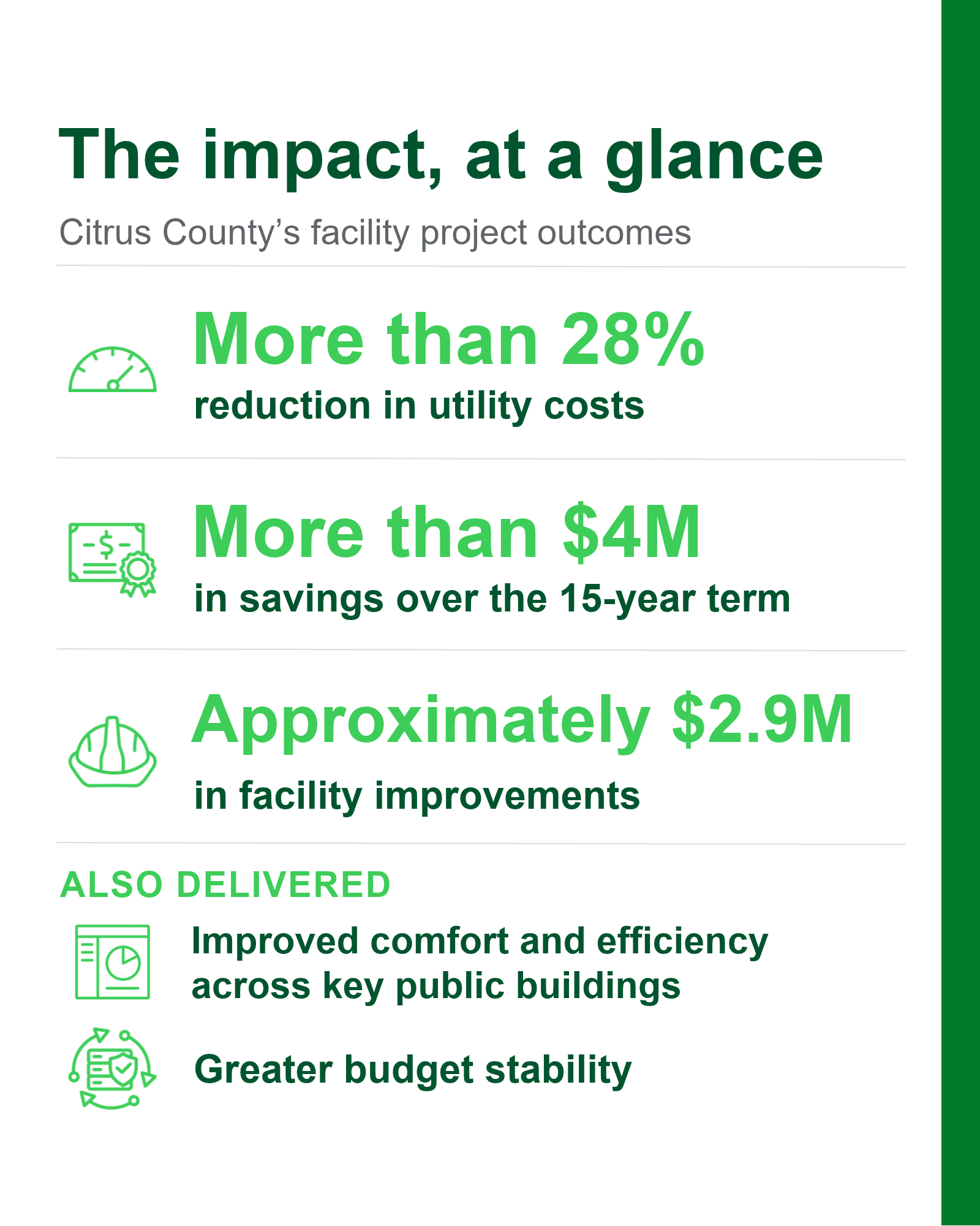
After the successful completion of project construction, the County immediately began realizing the guranteed project impact. Most importantly, the project helped free up public resources for
other community priorities. Instead of continuing the same level of spending on utility costs, Citrus County can now redirect savings toward assets that support residents, staff, and daily operations.
That is the core value of GESPCs during financial upheaval: they give public leaders a practical way to keep moving forward when capital dollars are limited and community expectations remain high.
Lessons for Public Agencies Today: A Practical Path Forward During Uncertain Times
Today, many public agencies are once again facing difficult financial conditions. Inflation, aging infrastructure, staffing shortages, and competing priorities are forcing leaders to make careful choices about where each dollar can have the greatest impact.
Citrus County’s experience offers several lessons.
1. Deferred maintenance has a cost
Waiting may feel safer in a tight budget year, but aging systems often become more expensive to operate and maintain over time. A structured efficiency project can help agencies address needs before they become more disruptive or costly.
2. Utility spending can become a funding source
Energy and operational savings can create a practical path to facility improvements. For agencies with limited capital funds, this can help reduce pressure on the general fund or other budget sources.
3. Guarantees support public accountability
A performance guarantee gives leaders a clearer way to manage risk and explain the project to boards, councils, and residents. It also creates a framework for measurement and reporting.
4. Transparency builds trust
Citrus County’s process included public discussion, staff input, financial review, and savings verification. That level of transparency is essential when public funds are involved.
5. Facility improvements support service delivery
Efficient, comfortable, reliable buildings help public employees do their work and help residents access services. The value is not only financial; it is operational and community-facing.
Citrus County did not wait for perfect financial conditions to address its facility needs. The County evaluated its options, asked hard questions, and chose a path that connected infrastructure investment to measurable savings.
For cities, counties, school districts, and public agencies facing similar challenges today, the lesson is clear: financial uncertainty does not have to mean standing still. With the right structure, clear accountability, and a practical implementation plan, public leaders can make facility improvements that support both current operations and long-term community value.
Is your municipality facing aging infrastructure and budget constraints? Contact us to learn more about how our performance contracting services can help.